The radial saw is a fixed-position equipment that has been used for a long time in most Anglo-Saxon countries in general and in the United States in particular. With its high performance in panel cutting, the radial saw allows for great cutting precision. This makes it an ideal tool for creating various assemblies. Discover in this article the usefulness of a radial saw.
What characterizes a radial saw?
The radial saw consists of a table and a perpendicular column to it. This column supports an arm at the end of which is the saw head that is directly connected to the motor. This head pivots on two axes: the horizontal axis and the vertical axis. It can also move forward and backward on the arm. Moreover, it can rise and fall from the column. Hence, the extreme maneuverability of the saw blade, which can work in almost any position.
Regarding the motor, the radial saw uses an electric motor that is quite powerful. This power ranges from 1 to 6 hp depending on the model. Here, the motor shaft has a left-hand thread. This ensures that the nut securing the blade tends to tighten, which is quite interesting for enhancing safety.
The cutting precision is guaranteed by the quality of the machining of the arm and the adjustment of the bearings. This means that the cut is as precise as it allows for a tolerance of one millimeter for a stroke of 1100 millimeters. You can learn more at www.scie-radiale.net/.
The use of a radial saw
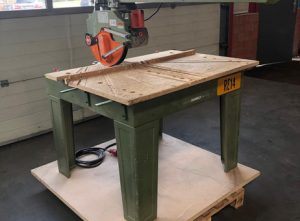 The extreme precision of the blade positioning and the ability to orient it in almost any position are advantages that make the radial saw a machine that remains quite versatile.
With the arm and the blade of the saw being perpendicular to the guide rail, it is possible to make straight cuts with a cross-cutting output as well as very precise grooving. By tilting the saw head until it is vertical, you can execute wide tenons and long grooves on end pieces. Furthermore, when you rotate the blade on its vertical axis, you will achieve miter cuts. Doing the same on the horizontal axis will yield bevel cuts.
Moreover, when you combine the bevel cut and the miter cut, you can achieve a cut known as the compound miter cut. This cut allows for creating mitred ends that no other machine could accomplish as quickly with such great precision.
These various adjustments are made using several side levers, in addition to a crank, which allows for a very precise height adjustment of the arm on the column. The radial saw is definitely a good saw that every DIY enthusiast should have.