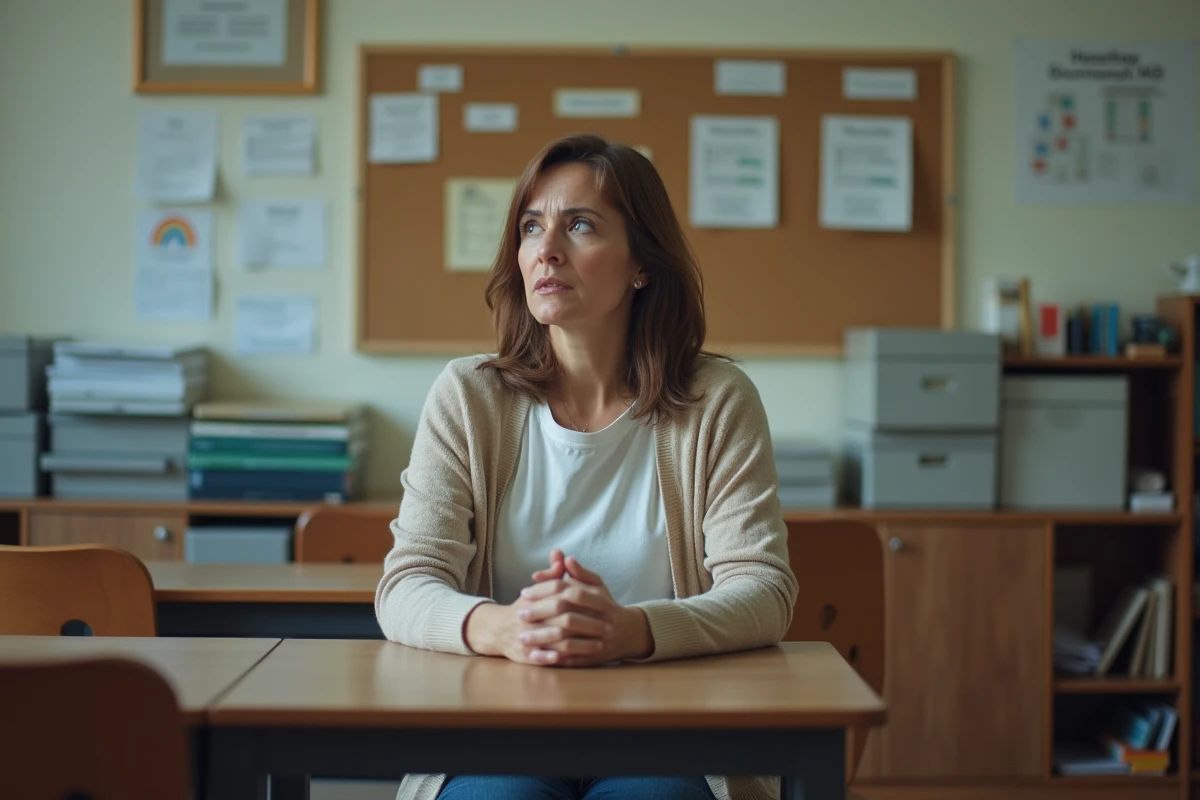
A report at school never warns in advance. It often falls like a guillotine: a failed meeting, a call from the administration, an official letter that surprises as much as it worries. Yet, behind the institutional procedure, it is primarily the protection of the child that is organized, away from prying eyes and noise, in a strictly confidential framework.
Most of the time, families learn about it without having been involved. The shock can be harsh, the approach may seem abrupt, but it all starts with a desire to protect the child. Parents find themselves facing immediate consequences, sometimes vague rights, and a feeling of loneliness that is often destabilizing. Few really know how all this is organized or where to find support.
When the school reports a situation: why and in what cases this happens
Nothing prepares you for the moment when the report made by the school strikes. A behavior that shifts, an unusual confidence, accumulating absences, sometimes a persistent worry from the teacher: often, it is from these signs that a team member alerts. Their role? To take note of the slightest doubt, to act quickly, and never to let an alert signal slip away.
The school does not position itself in an accusatory stance. It transmits the information, without condemning, without investigating itself. This relay aims only to raise a concern and to entrust the follow-up to other competent structures; it neither has the mandate nor the vocation to decide.
Several circumstances lead to this type of action from educational teams. The most frequently encountered situations are grouped here:
- Detection of violence against the student, whether physical or psychological, within the family circle or elsewhere
- Repeated failures in hygiene, access to care, or nutrition, even after discussions with parents
- Statements, attitudes, or gestures that suggest a risk of sexual abuse, even in the absence of certainty
- A sudden disengagement, unusual academic difficulties that could signal a family crisis or trauma
- The child’s isolation, the absence of a reference adult or regular support
When a concerning information surfaces, the institutional tempo accelerates. For parents, this upheaval is disconcerting, raises anxiety, and sometimes generates anger at what seems like an external judgment. But the logic remains unchanged: it is about understanding what the child is truly experiencing, determining whether they need support or intervention, without preconceived notions.
What steps to take after a report? What families need to know
Once the signal is transmitted, the Cell for Collecting Concerning Information (CRIP) of the department receives the case. Parents are quickly officially informed that a social investigation will be opened. A social worker then makes contact: they propose a meeting, usually at the family’s home, to better understand the situation and hear each person’s version.
During this time, parents retain their rights and parental authority, unless the urgency justifies immediate protective action. Depending on the assessment, several scenarios are possible: educational support, closure of the procedure if the alert is not confirmed, or judicial reporting if the situation remains concerning. For the school and its staff, failing to report when there is still a doubt would expose them to legal action, a sign of the rigor of this mechanism.
To navigate the steps following a report, it is useful to know the main phases of the procedure:
- First interview, often at home, to obtain an overview of the child’s environment
- Additional interviews conducted with other concerned adults (school doctor, teachers, sometimes relatives)
- Observation of family life and the child’s conditions, always in agreement with the parents or holders of authority
- If the risk does not diminish, the case may lead to a referral to the juvenile judge

Resources, support, and rights: how to get help in the face of a report
After the shock of the first contact, the administrative reality imposes itself, often confusing and destabilizing. Navigating this mechanism alone is never a necessity: several tools exist to avoid isolation.
119, Child in Danger, operates continuously, free of charge, with the utmost discretion. Advice, listening, discussions about what worries you: it is an immediate entry point. If the danger comes from digital situations, such as cyberbullying, 3018 takes over; for school bullying, it is 3020 that intervenes. These platforms provide initial support and redirect if necessary.
The defender of rights or the Defender of Children also intervenes: they explain the process, clarify, provide guidance to contest a procedure perceived as unfair, or advance cases with state institutions. Their intervention proves valuable during blockages with the administration or to break the feeling of powerlessness.
Associations and collectives, for their part, remain essential resources. They provide support, offer meetings, legal information, and practical help to reconstruct a situation or defend one’s interests. For anything related to the Internet and related reports, the Pharos platform remains the contact point.
Here are the main contacts to turn to for support or advice during a report:
- 119, available at any time to talk, inquire, or alert in the face of a persistent discomfort
- The defender of rights, to be mobilized as soon as the procedure blocks or if institutional relations become unclear
- Specialized associations, always present to guide and support during complex or conflicting processes
A report causes a frontal shock in family life. It shakes up references, brings doubts to the surface, and transforms daily life. But despite the violence of this upheaval, it also carries the hope of repair, a new point of balance, sometimes unexpected, sometimes salvatory.