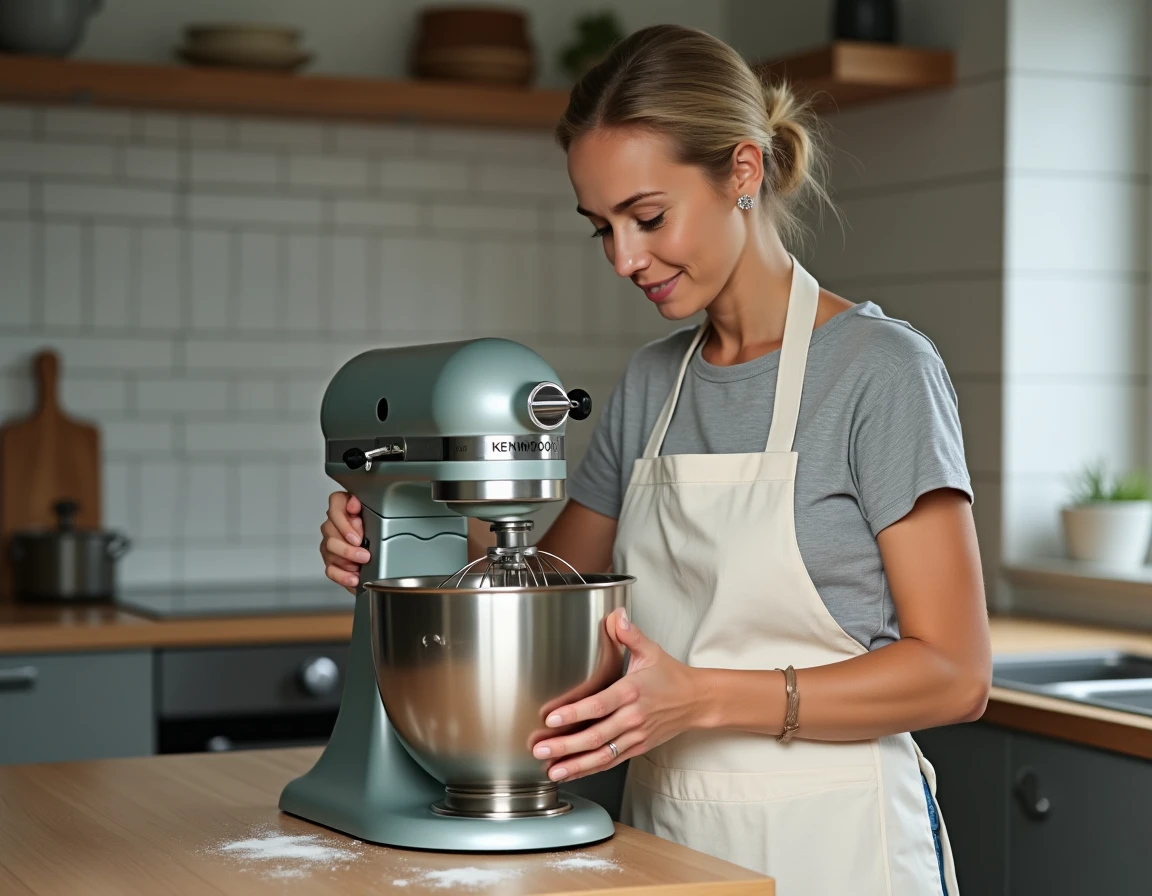
The bowl of a Kenwood stand mixer is never removed by simple vertical pulling. On most ranges, the system relies on a mechanism of alignment, rotation, and locking that requires precise handling. Understanding this logic prevents jams and preserves the mechanical parts in the long term.
Rotation Locking Mechanism on Kenwood Mixers
The principle is the same for the Chef, Titanium, and kMix ranges: the bowl is secured by clockwise rotation and released by counterclockwise rotation before lifting. On the Kenwood Titanium Chef Baker KVC85, the manual explicitly states that the bowl must be turned counterclockwise until it unlocks, then lifted gently.
This bayonet system relies on lugs located at the base of the bowl that engage in grooves on the base. Forcing vertically without prior rotation may deform these lugs or scratch the internal coating of the base.
On the KMX75 and KMX76 models, we observe that the speed control must be in the “O” (OFF) position before any attempt to remove the bowl. The safety system mechanically locks the bowl as long as the mixer detects an active position. Before handling anything, it is recommended to consult a detailed step-by-step guide to remove the bowl from the Kenwood mixer with Gastronomie du Jour, which allows you to verify the procedure suitable for your model.
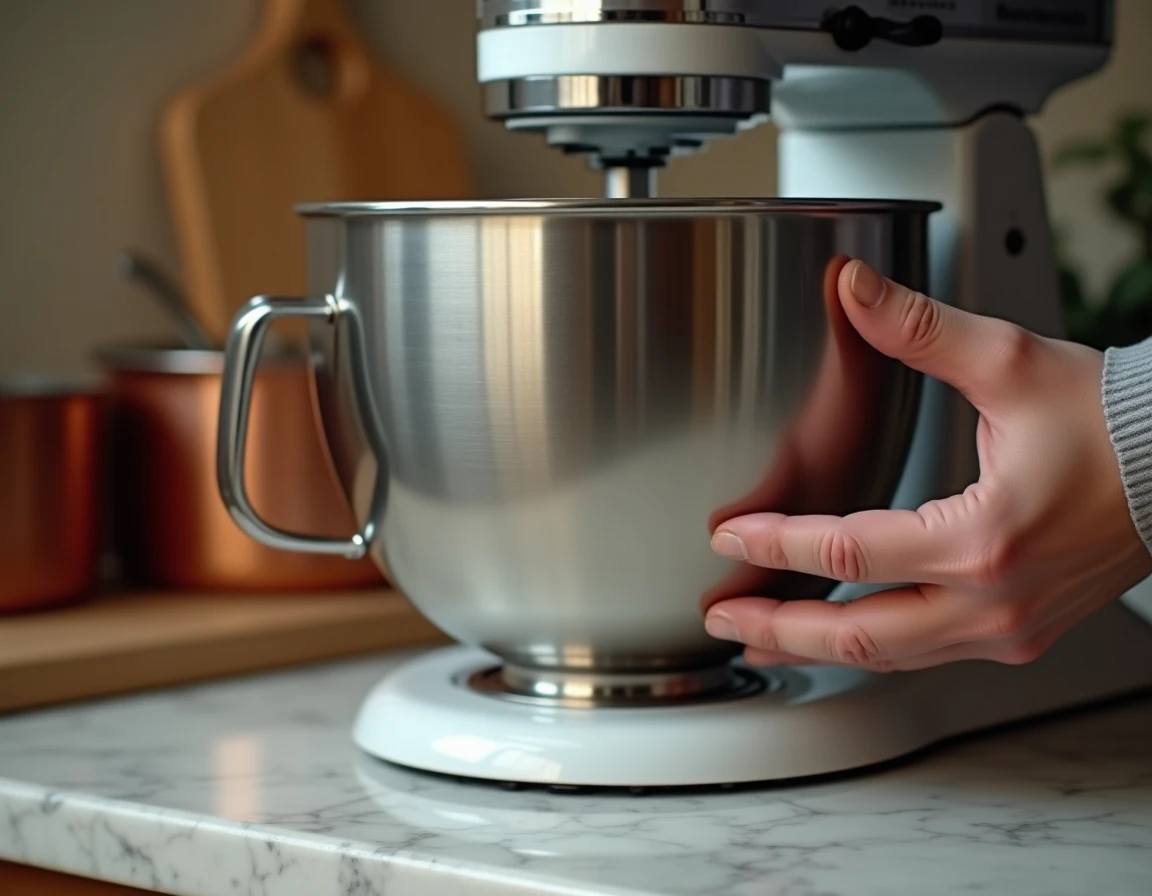
Stuck Bowl on a Kenwood Mixer: Common Technical Causes
A bowl that refuses to turn is not always a bowl problem. We recommend checking three points before forcing.
Incorrectly Positioned Rear Accessory
On the Kenwood Chef Premier, the rear cover intended for the blender or secondary accessories can interfere with the bowl release mechanism. A poorly replaced cover after using an accessory creates resistance that blocks rotation. Removing this rear cover and then attempting to unlock again resolves the situation in most cases.
Food Residues in the Base Grooves
Flour, powdered sugar, or dough splashes dry in the fixing grooves and seize the rotation. Regular cleaning of this area with a damp cloth (never direct water spray on the base) prevents accumulation. A simple dried residue is enough to block the bayonet.
Initial Misalignment
The manuals for the KVC85 and KVL85 ranges emphasize assembly by alignment before rotation. If the bowl was slightly misaligned during installation, the lugs are not in their normal locking position. The bowl seems stuck, while it is actually neither locked nor free. The solution is to apply slight downward pressure while attempting a clockwise rotation to realign, then perform the counterclockwise unlocking rotation.
Position of the Head Lever According to Kenwood Ranges
The unlocking control is not located in the same place depending on the models. On the Cooking Chef KCL96.004DG, the lever to lift the mixer head is located at the front of the device. On the classic Chef and Titanium ranges, it is found on the right side or at the back.
This difference in positioning explains why a user accustomed to one model struggles with another. The reflex to look for the lever in the same place leads to haphazard handling. We recommend always lifting the mixer head before attempting to remove the bowl, as the beater or dough hook still in the lowered position obstructs rotation.
On some models, the head does not lift but tilts. Pulling up instead of tilting back can give the impression that the mechanism is stuck, while it is functioning normally.
Maintenance of the Kenwood Bowl Fixing System
Targeted maintenance of the fixing parts extends the life of the mechanism and eliminates recurring jams. Here are the points to check after each intensive use:
- Wipe the lugs at the base of the bowl with a dry cloth to remove any traces of dough or liquid before they dry
- Check the condition of the base grooves by running a cotton swab along the notches, especially after preparing heavy doughs (bread, brioche)
- Apply a drop of food-grade oil to the lugs once or twice a year if rotation becomes difficult, without excess to avoid attracting residues
- Inspect the base seal of the bowl (present on some models) and replace it if it is cracked or deformed, as a damaged seal alters the seating height of the bowl in the base
Never submerge the mixer base in water. Cleaning the base is done exclusively with a wrung damp cloth. Water splashes in the internal mechanism cause corrosion on the locking metal parts, making rotation increasingly difficult over time.
When the Kenwood Bowl Remains Stuck Despite Everything
If the counterclockwise rotation does not work after checking the alignment, head positioning, and absence of interfering rear accessory, the problem may come from a deformed internal locking part. On older models, wear of the plastic lugs eventually alters their geometry.
In this case, forcing the rotation with a tool is to be avoided: the risk of breaking a lug turns a reversible problem into a bowl replacement. The approach is to contact Kenwood customer service or an authorized repairer, who has compatible spare parts for each reference.
A replacement bowl must exactly match the reference of the mixer. Kenwood bowls are not interchangeable between all ranges, even when their diameter seems identical. The depth of the lugs and the spacing of the grooves vary according to the series.